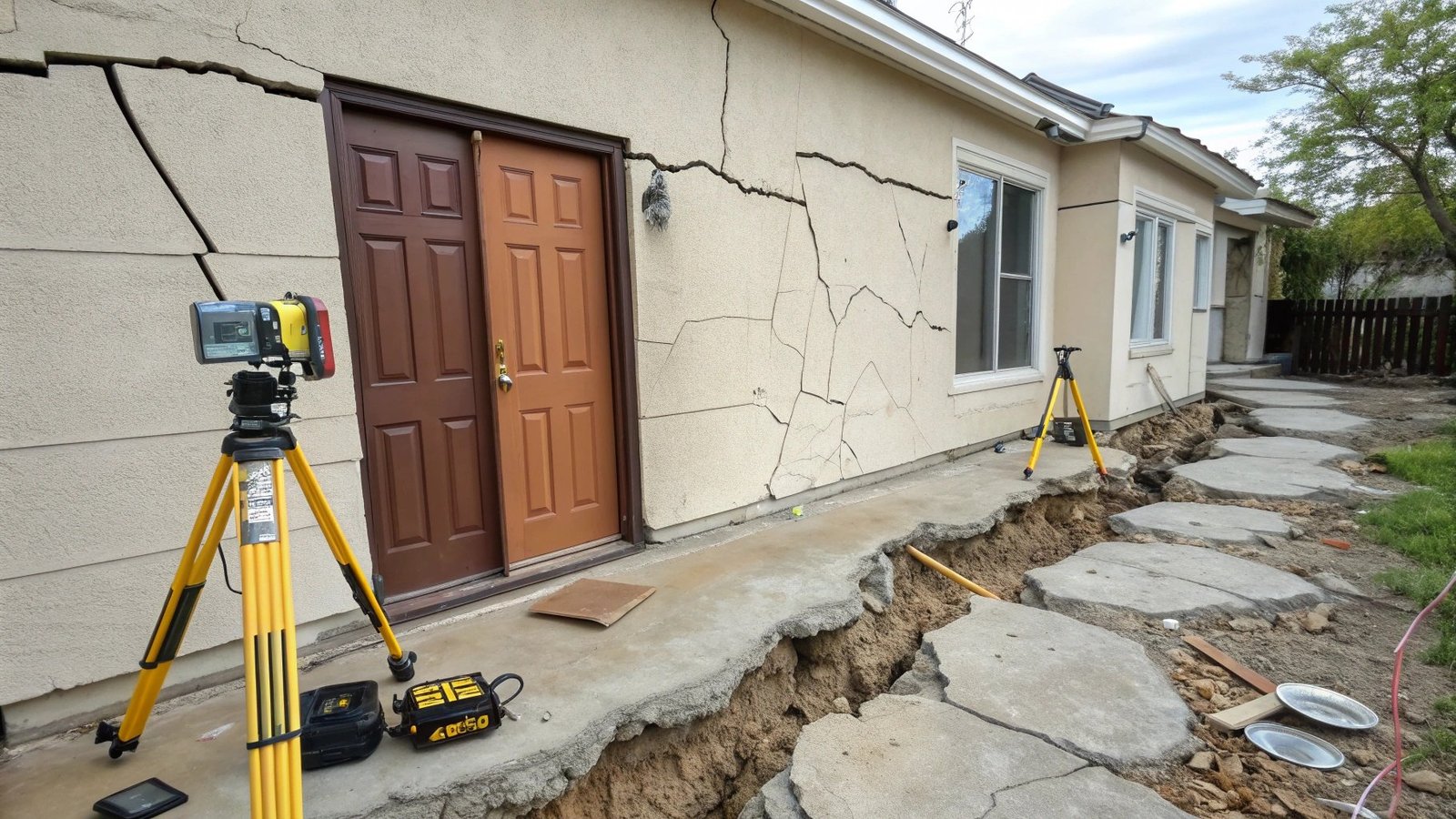
Subsidence is one of the most feared words in property transactions. The mention of it can derail purchases, complicate mortgages, and significantly impact property values. But what exactly is subsidence, how serious is it really, and should you walk away from a property showing signs?
As RICS surveyors in Preston with extensive experience assessing structural issues across Lancashire, we've evaluated hundreds of properties with varying degrees of ground movement. This comprehensive guide explains everything home buyers need to know about subsidence.
What is Subsidence?
Subsidence is the downward movement of the ground beneath a building's foundations, causing the property to sink. This sinking is usually uneven, affecting one part of the building more than others, which leads to structural damage.
Types of Ground Movement
It's important to distinguish between different types of movement:
1. Subsidence
- Downward movement of the ground
- Usually caused by soil shrinkage, mining, or underground erosion
- Most serious type of movement
- Can cause significant structural damage
2. Heave
- Upward movement of the ground
- Often follows subsidence when trees are removed
- Clay soil swells as moisture increases
- Can be as damaging as subsidence
3. Settlement
- Normal compression of soil under building weight
- Expected in new or recently extended properties
- Usually stops after initial settling period
- Rarely causes serious problems
4. Landslip
- Lateral movement on slopes
- Soil or rock moving downhill
- Less common but potentially severe
- Particularly relevant in hilly areas around Preston
This guide focuses on subsidence, though many principles apply to other types of structural movement.
Common Causes of Subsidence
1. Clay Soil Shrinkage (Most Common)
Clay soil expands when wet and shrinks dramatically when dry. In Lancashire, including Preston, Fulwood, and surrounding areas, clay soil is common.
Why Clay Causes Problems:
- Volume change: Clay can shrink up to 10% when dry
- Tree roots: Extract moisture from clay, causing shrinkage
- Hot, dry summers: Accelerate moisture loss
- Shallow foundations: Older properties often lack deep foundations
Seasonal variation: Clay-related subsidence often shows seasonal patterns - cracking worsens in summer, may close partially in winter.
2. Tree Root Activity
Trees are the single biggest cause of subsidence claims in the UK, particularly affecting Victorian and Edwardian properties with shallow foundations.
High-Risk Trees:
- Oak: Extensive root systems, high water demand
- Willow: Extremely thirsty, roots seek water aggressively
- Poplar: Fast-growing, moisture-hungry
- Elm: Deep, widespread roots
- Ash: Significant water consumption
- Sycamore: Large root spread
Risk Factors:
- Distance: Trees within 1.5x their mature height are concerning
- Species: Some trees much riskier than others
- Soil type: Clay amplifies tree-related risk
- Foundation depth: Shallow foundations more vulnerable
Real Preston example: A Victorian terraced property in Ashton had severe subsidence from a neighbor's oak tree just 8 meters away. Root barriers and underpinning cost £35,000, but the tree remained.
3. Water Leaks
Water can wash away or soften soil beneath foundations:
- Leaking drains: Underground pipes eroding soil
- Burst water mains: Sudden soil saturation
- Defective guttering: Water pooling near foundations
- Poor site drainage: Chronic water accumulation
Case study: A property in Fulwood showed subsidence that traced back to a leaking drain that had gone undetected for years, creating a void beneath the foundations.
4. Mining and Extraction
Lancashire has a mining history, particularly coal mining:
- Old mine workings: Can collapse decades after closure
- Solution features: Underlying salt or limestone dissolution
- Made ground: Properties built on infilled quarries
Mining searches are essential in Preston and surrounding areas - historic mining activity is more widespread than many buyers realize.
5. Property Changes
- Extensions: New loadings on inadequate foundations
- Conservatories: Often built with insufficient foundations
- Removed internal walls: Altered load distribution
- Added weight: Loft conversions, additional stories
6. Weather and Climate
- Prolonged drought: Extreme clay shrinkage
- Heavy rainfall: Soil saturation and heave
- Climate change: More extreme weather patterns
- Seasonal cycles: Repeated expansion and contraction
Recognizing Signs of Subsidence
Not all cracks indicate subsidence, but certain patterns are concerning. As Preston surveyors, here's what we look for:
Warning Sign Cracks
High-Risk Crack Patterns:
- Diagonal cracks: Running at 45° from corners of windows/doors
- Stepped cracks: Following brick/block courses in a staircase pattern
- Wide cracks: Over 3mm width, especially if widening
- Internal and external cracks aligning: Through-wall cracking
- Cracks wider at top than bottom: Suggesting foundation drop
Less Concerning Cracks:
- Fine hairline cracks: Under 1mm, often just cosmetic
- Horizontal cracks: At wall/ceiling junctions (usually settlement)
- Vertical cracks: At corners (often thermal movement)
- Regular pattern cracks: Throughout property (settlement)
Other Subsidence Indicators
- Doors sticking: Frames distorting out of square
- Windows won't close: Frames twisted
- Sloping floors: Particularly if getting worse
- Gaps around frames: Between doors/windows and walls
- Rippling wallpaper: Over cracking plaster
- External signs: Leaning walls, bulging brickwork, tilting chimneys
Investigation Questions
When you spot potential subsidence signs, ask:
- Is the damage recent or historic? Fresh cracks vs old painted-over cracks
- Is it active or stable? Getting worse or unchanged for years?
- What's the pattern? Localized or throughout property?
- Are there obvious causes? Nearby trees, drainage issues, extensions?
Important: Only a RICS surveyor can properly assess whether cracking indicates active subsidence. Don't rely on seller assurances.
Professional Subsidence Investigation
When to Commission Investigation
Detailed investigation is necessary when:
- Your building survey identifies potential subsidence
- Your mortgage lender requires structural assessment
- You're buying a property with known subsidence history
- Significant cracking is evident
Investigation Process
Stage 1: Initial Assessment
- Detailed inspection: All cracks measured and recorded
- Crack monitoring recommended: Usually 6-12 months
- Potential causes identified: Trees, drains, soil type
- Historic research: Previous issues, repairs, insurance claims
Stage 2: Monitoring (If Required)
- Crack monitoring gauges: Installed across cracks
- Regular readings: Usually quarterly
- Seasonal patterns observed: Opening/closing cycles
- Rate of movement calculated: Active vs stable
Stage 3: Detailed Investigation (If Necessary)
- Trial pits: Excavating to expose foundations
- Borehole investigation: Soil analysis beneath property
- CCTV drain survey: Checking for leaks
- Tree root location: Specialist root mapping
- Structural engineer assessment: Foundation adequacy
Investigation Costs
- Initial assessment: Included in detailed building survey (£600-£1,200)
- Structural engineer report: £500-£1,500
- Monitoring (6-12 months): £300-£800
- Detailed investigation: £2,000-£5,000+
Who pays? Usually the buyer commissions investigation, though sometimes negotiable with the seller if problems discovered mid-transaction.
Subsidence Repairs: What's Involved
Treatment Options
1. Addressing the Cause
Often the first and most important step:
- Tree management: Pruning, removal, or root barriers (£500-£10,000)
- Drainage repairs: Fixing leaking drains (£1,000-£5,000)
- Improved drainage: French drains, better guttering (£500-£3,000)
- Resolving water issues: Whatever is affecting soil moisture
Important: Simply underpinning without addressing the cause means problems will recur.
2. Underpinning
Strengthening or deepening foundations:
Traditional mass concrete underpinning:
- Excavating beneath existing foundations in sections
- Pouring concrete to extend foundation depth
- Most common method
- Cost: £10,000-£50,000+ depending on extent
Mini-piled underpinning:
- Steel piles driven down to stable ground
- Used when traditional underpinning inadequate
- Less disruptive but more expensive
- Cost: £20,000-£60,000+
Beam and base:
- Reinforced concrete beam spanning weak areas
- Good for localized problems
- Cost: £15,000-£40,000
3. Resin Injection
- Expanding resin injected beneath foundations
- Consolidates and lifts
- Less invasive than traditional underpinning
- Not suitable for all subsidence types
- Cost: £5,000-£20,000
4. Monitoring and Cosmetic Repair
- If subsidence has stopped, major structural work may not be needed
- Simply repair cracking and monitor
- Much cheaper but requires confidence subsidence is inactive
- Cost: £2,000-£8,000
Repair Process Timeline
- Investigation and design: 2-6 months
- Obtaining approvals: Building control, insurers (1-2 months)
- Underpinning works: 4-12 weeks depending on scale
- Cosmetic repairs: 2-6 weeks
- Total: Typically 6-12 months from start to finish
Living Through Repairs
- Major underpinning usually requires vacating property
- Significant disruption to gardens and driveways
- Noise, dust, and access issues
- Insurance typically covers alternative accommodation
Insurance and Subsidence
Making a Claim
If you discover subsidence in a property you own:
- Contact your insurer immediately
- They'll appoint a loss adjuster and structural engineer
- Investigation commissioned (insurer pays)
- If claim accepted, insurer funds repairs
- You pay the excess (typically £1,000-£2,500)
Policy Excesses
- Subsidence excesses much higher than standard excesses
- Typically £1,000-£2,500
- Some older policies have higher excesses
- Check your policy carefully
Future Insurance
After a claim or purchasing property with subsidence history:
Expect:
- Higher premiums: 20-50% increase typical
- Higher excesses: £2,500-£5,000 for subsidence
- Exclusions: Sometimes subsidence excluded entirely
- More questions: Detailed disclosure requirements
After Professional Repairs:
- 10-year guarantee from repair contractor helps insurability
- Structural engineer's report confirming stability essential
- Premiums reduce over time if no further issues
- After 10+ years of stability, may return to normal premiums
Disclosure Requirements
You MUST disclose:
- Any previous subsidence or structural movement
- Any repairs undertaken
- Any insurance claims (even if claim withdrawn)
- Any ongoing monitoring
Failure to disclose voids your insurance - even unintentional non-disclosure can leave you uninsured.
Buying a Property with Subsidence
Should You Walk Away?
Not necessarily. Consider:
Walk Away If:
- Active ongoing subsidence with no clear solution
- Seller won't provide guarantees or investigation reports
- Repairs are obviously inadequate or poorly documented
- You can't get insurance at any reasonable price
- Mortgage lender refuses to lend
- Cause hasn't been addressed (e.g., problematic tree still present)
Consider Proceeding If:
- Historic subsidence, professionally repaired, with guarantees
- 10+ years since repair with no recurrence
- Clear cause that's been resolved
- Significant price reduction compensates for risks
- You can obtain insurance (even if more expensive)
- Mortgage available from specialist lenders if needed
Negotiating Price Reductions
Subsidence history significantly affects value:
- Recent active subsidence: 20-50% reduction appropriate
- Recently repaired: 10-25% reduction
- Historic (5-10 years ago): 5-15% reduction
- Old (10+ years), no recurrence: 0-10% reduction
Factors affecting negotiation:
- Quality of repair documentation
- Length of guarantee remaining
- Evidence of stability
- Insurance availability and cost
- Impact on future resale
Real Preston example: A Victorian semi in Fulwood had subsidence repaired 8 years previously with full documentation and 10-year guarantee. Initially listed at £285,000, buyer negotiated to £265,000 (7% reduction) based on future insurance costs and resale considerations.
Questions to Ask Seller
- When was subsidence first noticed?
- What investigation was undertaken?
- What caused it?
- What repairs were done and when?
- Who carried out the work?
- Is there a guarantee? How long remaining?
- Has there been any movement since repair?
- Are there structural engineer reports available?
- What did insurance company require?
- Has the cause been permanently addressed?
Documentation You Need
Essential documents before proceeding:
- Original structural engineer investigation report
- Specification of works undertaken
- Contractor's guarantee (ideally 10 years)
- Building control completion certificate
- Insurance claim correspondence
- Recent structural engineer confirmation of stability
- Before and after photographs
If seller can't provide these, be extremely cautious.
Mortgage Considerations
Lenders vary enormously in their subsidence policies:
Some Lenders:
- Won't lend at all on properties with subsidence history
- Require monitoring period to show stability
- Demand retention (holding back funds until satisfied)
- Accept with adequate documentation and guarantees
Mortgage broker essential - they'll know which lenders are subsidence-friendly.
Prevention and Risk Reduction
For Existing Homeowners
- Manage nearby trees: Regular pruning, crown reduction
- Maintain drainage: Keep gutters clear, repair leaks promptly
- Monitor cracks: Take photos annually, measure significant cracks
- Avoid planting large trees close to buildings
- Don't remove established trees suddenly (can cause heave)
- Ensure extensions properly founded
For Buyers
- Commission building survey on all older properties
- Ask about trees - who owns them, species, age
- Check mining reports for Lancashire properties
- Look for tell-tale signs during viewings
- Research property history - previous sales, price reductions
Subsidence Myths Debunked
Myth: All Cracks Mean Subsidence
Reality: Most cracks are harmless settlement or thermal movement. Subsidence causes specific crack patterns in specific locations.
Myth: Underpinning Adds Value
Reality: Properties with underpinning history are worth less than identical properties without, even with guarantees. It's a stigma that affects resale.
Myth: New Houses Don't Get Subsidence
Reality: While less common, new builds can suffer subsidence, particularly if built on made ground or near established trees.
Myth: You Can't Get Insurance After Subsidence
Reality: You can, but it's more expensive. Specialist insurers exist for difficult cases.
Myth: Small Cracks Are Nothing to Worry About
Reality: While often harmless, small cracks in concerning patterns or locations warrant professional assessment.
Conclusion: Informed Decisions
Subsidence is serious but not necessarily a deal-breaker. The key is understanding what you're dealing with and making informed decisions based on professional advice.
Key Takeaways:
- Not all ground movement is subsidence
- Not all subsidence is catastrophic
- Professional investigation is essential for proper assessment
- Historic, repaired subsidence is often acceptable if well-documented
- Active, unexplained subsidence requires extreme caution
- Price reductions should reflect real costs and risks
- Insurance and mortgage availability are critical considerations
- Prevention through tree and drainage management is worthwhile
As Preston surveyors, we've helped countless buyers navigate subsidence concerns. Some proceeded confidently with reduced offers; others wisely walked away. The difference was always the quality of information available and honest professional advice.
Concerned About Subsidence?
Our experienced RICS surveyors provide comprehensive building surveys that identify and assess subsidence risks in properties across Preston, Fulwood, and Lancashire. We'll give you the honest, expert advice you need to make confident property decisions.
Book Your Building Survey